
Web Harmonium Sheet Music: Master the Sargam Online
The Foundation of Indian Music: Understanding Sargam
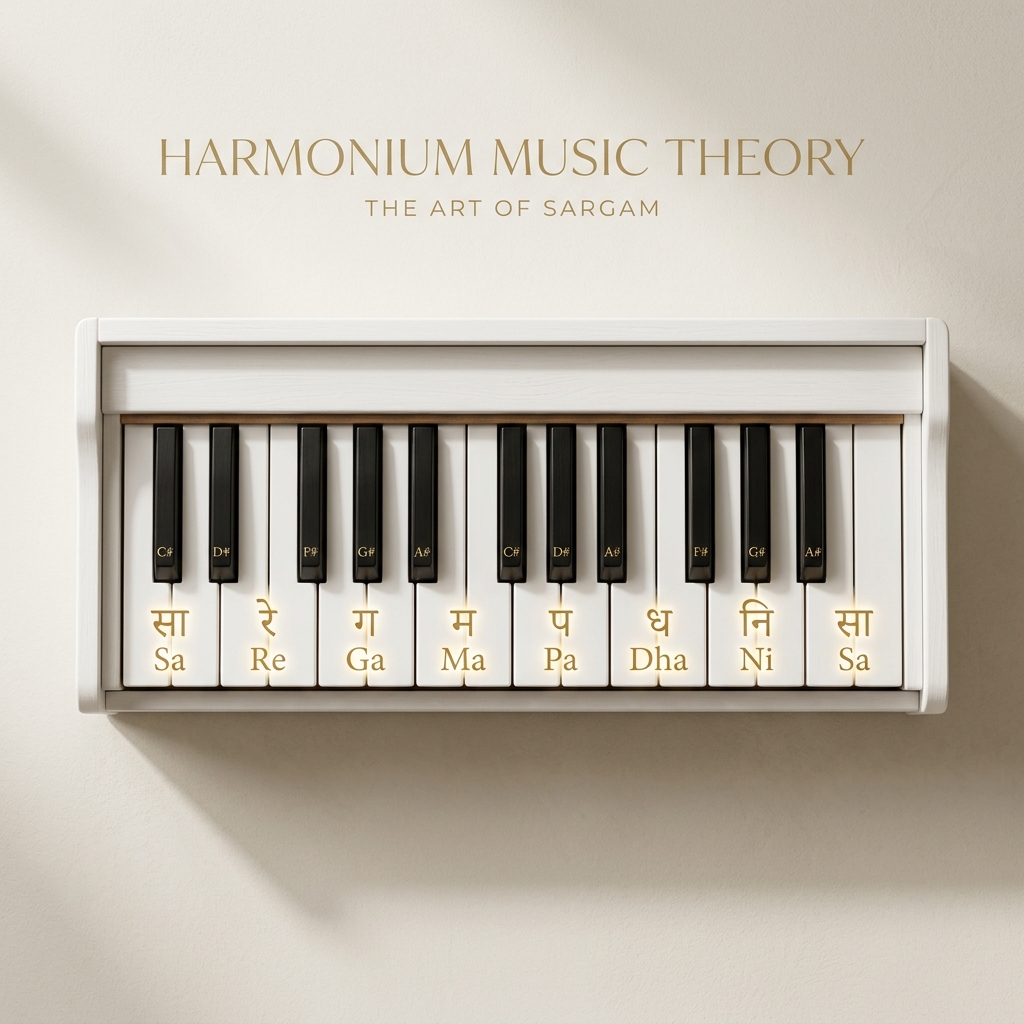
Sargam is the alphabet of Indian music. Standing for Sa, Re, Ga, Ma, Pa, Dha, Ni, it is the foundation upon which every Raga, Bhajan, and Bollywood hit is built. For a harmonium player, mastering Sargam is the equivalent of a pianist learning their scales. On WebHarmonium.io, we have meticulously mapped these notes to provide the most intuitive online harmonium practice experience available today.
The 12 Notes: Shuddha and Vikrit
While the basic Sargam consists of 7 notes, a full octave contains 12 semitones. In Indian music, we have 7 Shuddha (pure) notes, 4 Komal (flat) notes, and 1 Tivra (sharp) note. Our virtual harmonium keyboard uses the standard QWERTY layout to help you navigate these seamlessly.
- Sa (C): Key [E] - The Root
- Re (D): Key [R]
- Ga (E): Key [T]
- Ma (F): Key [Y]
- Pa (G): Key [U]
- Dha (A): Key [I]
- Ni (B): Key [O]
Mastering the "Palta": Advanced Rhythmic Exercises
A "Palta" is a permutation or a sequence of notes. Practicing Paltas is essential for building finger speed and mental agility. Let's look at three essential Paltas you can practice right now in our interactive sheet music mode:
Palta 1 (The Skip): Sa-Ga, Re-Ma, Ga-Pa... This exercise teaches your fingers to jump over notes accurately. On your keyboard, this corresponds to [E-T], [R-Y], [T-U].
Palta 2 (The Wave): Sa-Re-Ga, Re-Ga-Ma, Ga-Ma-Pa... This creates a flowing, wave-like melody that is common in devotional Bhajans. Practice this with the Reeds set to 2 for a clear, crisp tone.
Palta 3 (The Cascade): Sa-Re-Ga-Ma, Re-Ga-Ma-Pa... This is the ultimate speed builder. Once you can play this at 120 BPM without errors, you are ready for advanced compositions.
The Meditative Power of Riyaz
In the Indian tradition, practice is called "Riyaz." It is more than just technical training; it is a form of meditation. By sitting with your free web harmonium and holding a long "Sa" (the tonic), you align your focus and breath. Our engine's drone simulation allows you to maintain this meditative state even without a physical bellows. Set your volume to 50%, turn on the Coupler, and simply listen to the harmonics for five minutes before your main session.
Visualizing the Keyboard: A Digital Advantage
One of the biggest hurdles for beginners is memorizing which key corresponds to which note. Traditional harmoniums don't have labels. Our platform offers a **Practice Legend** that can be toggled on. It shows you the MIDI values and the Sargam names directly on the keys. Use this as a "crutch" for the first week, but try to turn it off as soon as your muscle memory takes over.
How to Use the Transpose Feature for Your Scale
Every singer has a different "natural" Sa. Males often sing from C or C#, while females may sing from G or G#. On our Harmonium Console, you can use the Transpose slider. If you move it to +7, your 'E' key will now sound as a 'G'. This allows you to practice the exact same finger patterns while producing the correct pitch for your voice. This is a level of flexibility that even expensive physical harmoniums cannot offer!
Developing Proper Posture and Touch
Even though you are playing on a computer keyboard or a tablet, posture matters. Keep your wrists level with the keyboard. Avoid "heavy fingers"—the harmonium is a wind instrument, and a light, nimble touch allows the virtual reeds to vibrate more freely. Our Vintage Digital Craft captures the release samples, meaning the sound decays naturally just like a real reed losing air.
Conclusion: Practice Makes Perfect
Whether you are learning for spiritual reasons, for Bollywood, or for classical study, the Sargam is your gateway. By combining our interactive practice mode with these theoretical deep-dives, you are setting yourself up for success. Check out our Bollywood guide once you feel comfortable with your scales!